Scrambling is essential for the healthy development of the Japanese game industry. However, the situation faced by Japanese handmaidens is not encouraging. As profits and opportunities continue to shrink. A growing number of distributors have begun to turn to the mainframe game market, resulting in mobile end developers facing double pressures of skill mismatches and age discrimination.

Japan’s “inner roll” among scavengers is becoming more and more serious, with the recent closure of the “Square Enix”, the “hand-showing plant”, of the operation of The Last Fantasy: A Revelation of Courage, and the Fight for the Dragons by Star Warriors, reflecting industry difficulties. A Japanese game producer on social media pessimism says, “The chances of a job at a twisting game are diminishing.”
Analysts believe that the sub-market has saturated — although distributors rely on them to stabilize cash flows, the limited time of players makes it difficult for multiple products to coexist. He explained: “Continuing in this industry, like a sinking ship, may not sink, but it is clear that the level of security on the surface is diminishing. Honestly, I feel the limits of my career. Even if I continue to play social games like this, there will be no further development in the future, and I don’t even know how long I can sit in my current seat.”
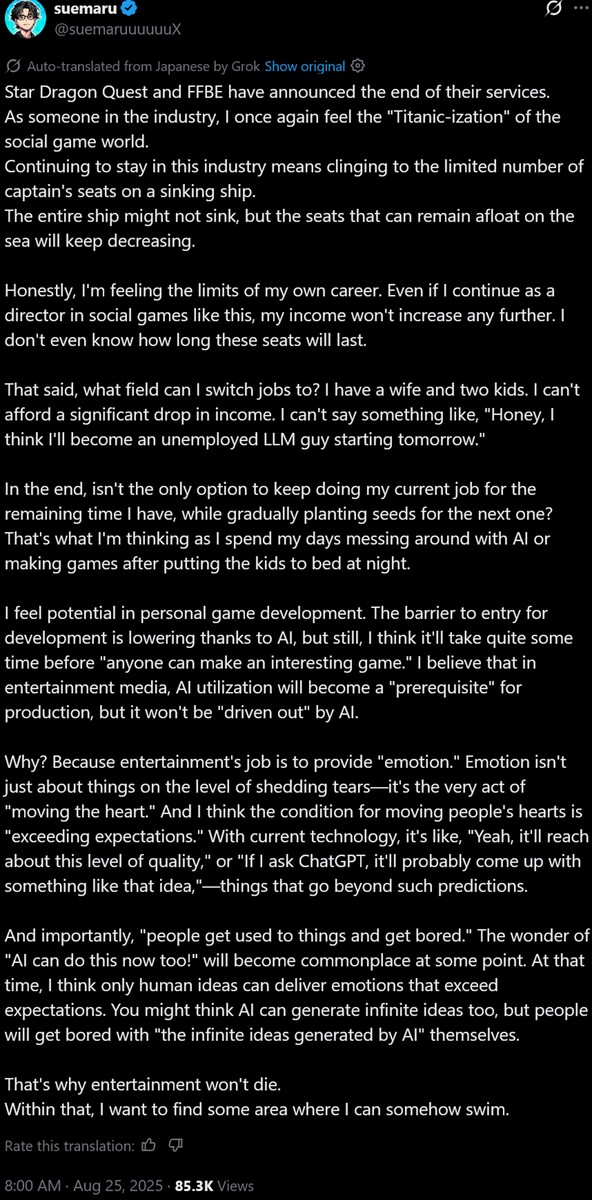
To make matters worse, new opportunities in the field of mainframe games require the ability of developers to apply sophisticated visual techniques, which are the skills blind for many twisting game developers. The tendency of industry to favour young candidates further complicates the transition of senior developers.
The rise of the Oracle redefined the standards of the industry and achieved results beyond the reach of competitors. In contrast to most of the previous hand-swap in the market, the Gods created a 3D world of 3As for players, and Miha had succeeded in transplanting The Gods of Gods, Crash: The Star Dome, to such mainframe platforms as PS5.

The entry of Chinese and Korean distributors has put more pressure on the already crowded Japanese spraining market. In spite of the challenges, the prospect of a free spraining game remains considerable. Business Research Insights predicts that the global market size will increase from $530 million in 2025 to $1.09 billion in 2034. In the future, the twisting game will continue to evolve into old models that break the static context, but developers may be eliminated if they fail to adapt to change.