The British Competition Appeals Tribunal has recently approved a $900 million class action against V. Steam’s direct competitor, the chief executive officer of Epic Games, Tim Sweeney, has been making little public criticism of Steam, and this time he did not make the expected supportive statement. On the basis of its experience in legal proceedings with Apple and Google, Sweeney found the case to be well founded.
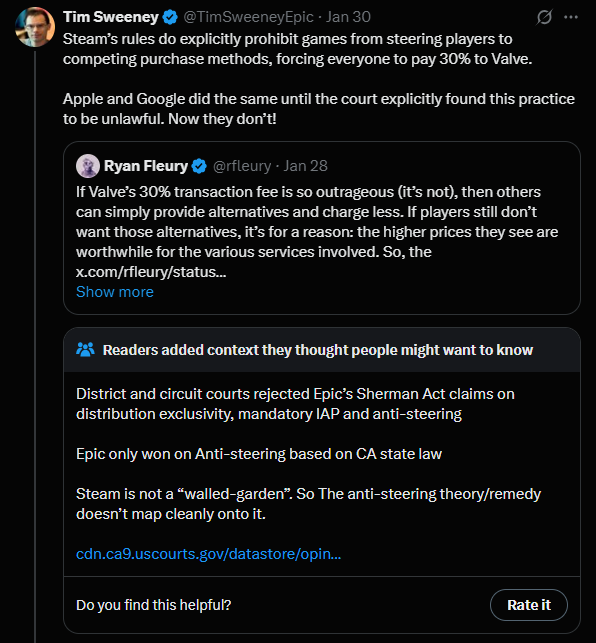
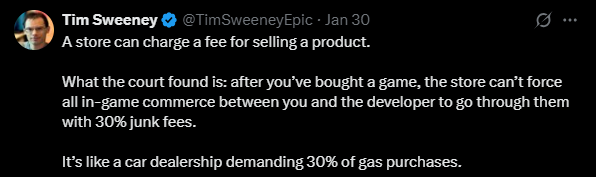
The suit was filed in 2024, inter alia, alleging that V Society had unfairly prevented game developers from providing lower prices in Steam and requiring that all additions to game purchases in Steam must be traded through Steam, whose “30 per cent overdrawn” ultimately led to a premium for British consumers. V had argued that the case should not be advanced in the form of a class action, and the Competition Appeals Tribunal had ruled last week that the case would continue. In the case of Steam, Sweeney focused particularly on the sale of DLC. Although developers can sell DLCs on other platforms and link them to Steam ‘ s account, V Society prohibits developers from selling additional items directly through insider shops or using game interfaces to direct users to outside platforms for purchase. Sweeney compared this to “the 30 per cent share of the car dealer’s oil bill”, which is also a central claim in the fight against Apple and Google law.
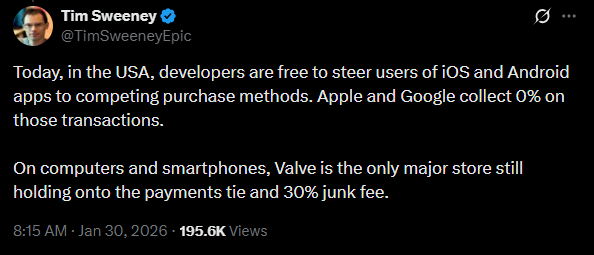
Despite the opposition of some practitioners, Sweeney maintains: “In the United States, IOS and Andre Applications Developers are now free to direct users to alternative payment methods, apples and Google cannot be drawn from these transactions, while at the PC and mobile end, V Society is the only large store that still insists on the payment of the bundle and 30 per cent of the waste bill.”
In response, Sweeney repeatedly acknowledged that the Steam game CDK and the DLC could be purchased through other platforms, but repeatedly stressed that the problem was that “the developers cannot provide the player with alternative purchase options in the game while complying with the V social rules”. This allegation coincides with Epic’s core claims against Apple and Google. Although Epic was not directly involved in the lawsuit, it was one of the founding objectives of the Epic Game Shop that challenged Steam ‘ s 30 per cent withdrawal and exclusion policy. Sweeney even spoke in 2019, and if Steam were to drop to 12 per cent, he would give up Epic shop to own the game and consider bringing Fort Night to Steam.

Epic has repeatedly demonstrated his determination to challenge global giants. It may be an exaggeration to take up 30 per cent of Steam’s share as “spam costs”, but it is undeniable that, with the push of companies like Epic, the game industry is moving away from this high-spacing pattern. Steam can maintain high levels of extraction and strict policies, which stem from its market dominance. But if the British lawsuit (and similar actions being prepared in the United States) were to be detrimental to V, its policies would probably have to be significantly adjusted.